The Thermos Was My Ticket In: A New Muslim at the Village Bonfire
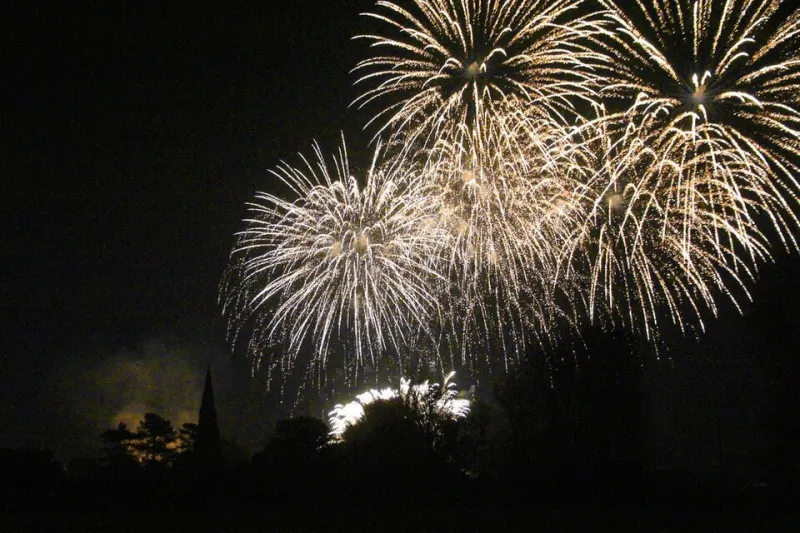
Photo: Richard Croft , CC BY-SA 2.0, via Wikimedia Commons
The invitation arrived in the school WhatsApp group in that way school WhatsApp groups do: a cheerful poster, a deadline for the PTA raffle, and a follow-up message from a parent called Claire asking who was bringing a gazebo. Bonfire Night was coming, and our village was doing what villages do — a fireworks display on the recreation ground, a pub fundraiser beforehand, and a general assumption that everyone would turn up in a coat and pretend the cold was character-building.
I had been Muslim for just over a year. This was my first November in the village as a visibly practising convert, and my first Bonfire Night as what I suspected would be the only Muslim at the display. As far as I knew, anyway. I am always careful with that phrase. You never actually know who is standing next to you in a crowd, or what they believe, or what they are carrying quietly. But I knew I was nervous, and nervousness has a way of making you feel like the only one of anything.
The Invitation in the School Group Chat
For a few days, I did the usual mental arithmetic. Did going mean I was pretending to be someone I was not? Did staying home mean I was letting my faith shrink me into a corner? Bonfire Night is not a religious festival. It is gunpowder, history and a slightly chaotic village gathering. But it is also a pub fundraiser, a muddy field, a lot of small talk and, in my experience, a hip flask of something warming making its rounds. None of those things are haram in themselves. The pub is just a building. The small talk is just small talk. The hip flask is a question I can answer politely.
What I actually feared was less dramatic. I feared being seen as the awkward one. I feared the moment when someone offered me a drink and I said no, and the conversation did that little British wobble before someone rescued it by talking about the weather. I feared the school-gate mums thinking I was judging them, or the opposite — that I was somehow there under false pretences. I feared the gap between being invited and being known.
So I went. I put on two pairs of socks, dug out the thermos, and made tomato soup. Not because I am a model convert with a perfect plan, but because soup is useful. It gives you something to do with your hands. It gives you something to offer. It turns you from a spectator into a small, warm part of the evening.
The Pub Fundraiser and the Raffle Ticket
The pub fundraiser was the first hurdle. The village pub had that golden-hour glow of a place where everyone already knows where the glasses live. I bought a raffle ticket from a man in a fleece who asked if I was a new face, and I said I had moved in about eighteen months ago. He said, 'Ah, you're the one in the house with the good hedge.' I have never been so pleased to be reduced to a hedge.
I did not drink. I had a lemonade and a packet of crisps and stood near the fire, which was doing more for my sense of belonging than any conversation could. Someone asked if I wanted mulled wine. I said no, thank you, I do not drink. They said, 'Fair enough, more for me,' and that was that. No lecture needed. No long explanation. No audience. Just a boundary that was respected and a raffle that I lost with dignity.
That sounds small, but it was not. One of the quieter lessons of conversion is that people are often much less interested in making you justify yourself than you expect. The drama is usually in our own heads. The pub did not turn into a theological examination. It turned into a raffle, a plate of chips and a conversation about whether the council would ever fix the pothole outside the school.
A Hip Flask, Politely Declined
Later, on the recreation ground, a neighbour offered me his hip flask. He is a kind man who has fixed my fence, lent me a ladder and once rescued a football from my garden with the quiet efficiency of someone who has been doing village life for decades. He held out the flask and said, 'Go on, it'll keep the cold out.'
I said, 'Thanks, but I don't drink. I've got soup.'
He looked at the thermos. 'Tomato?'
'Tomato.'
'Good choice,' he said, and that was the end of it.
I have thought about that exchange more than it deserves. It was not a rejection of him. It was not a rejection of Bonfire Night. It was just a small, clear answer. I am not there to pretend I am exactly like everyone else. I am there to be there. The two are not the same thing, and I think that distinction gets lost when converts are told either to assimilate completely or to opt out entirely.
Soup, Sparklers and Standing at the Back
The display itself was as British as promised: a slightly damp field, a soundtrack that jumped from pop to something vaguely orchestral, children waving sparklers with a level of supervision that varied by parent, and a bonfire that sent smoke straight into the eyes of anyone who had chosen the wrong side of the rope. I stood at the back. I like standing at the back. You can see the whole crowd, and you can leave without disturbing anyone.
A child from my son's class came over to ask if I had seen the giant rocket. I said I had. He said it was 'well loud.' I agreed. His mum offered me a mince pie. I offered her soup. We stood there eating and watching the sky go pink and gold, and nobody asked me to explain myself.
That is the bit I want to remember. Not the historical guilt-by-association of a 400-year-old plot, or the awkwardness I had built up in my head, but the ordinary exchange of food and small talk. The thermos did what the thermos was for. It made a bridge.
What the Night Actually Asked of Me
Bonfire Night did not ask me to sing a hymn, make a speech or wave a flag. It asked me to turn up, be warm, be honest about a hip flask, and help a child find his glove. It asked me to let people be kind in the way they know how, and to be kind back in the way I know how. It asked me to hold a boundary without turning it into a wall.
That is not a compromise of faith. It is just community. It is the same skill I need at the school gate, in the queue at the post office and in the awkward gap before a parents' evening starts. You do not have to become someone else to belong somewhere. You have to be present, and you have to be clear, and you have to accept that some evenings will be mostly about potholes and raffle tickets.
The Small Talk Is the Point
We left before the last firework. My son was tired, my feet were cold and the soup was gone. On the walk home, he asked if we could go again next year. I said yes. He asked if we could make soup again. I said yes. He asked if Bonfire Night is a Muslim thing. I said no, it is a village thing, and we are part of the village.
That is not a grand statement of belonging. It is just true. I do not need every tradition to be mine in a religious sense. I need to know that I can stand at the back of a field in November, holding a thermos, watching sparks fall over a place I am slowly learning to call home. That is enough. More than enough, actually. It is a very good place to start.