Wudu in a Station Toilet and Other Small Victories: Praying Through the Daily Commute
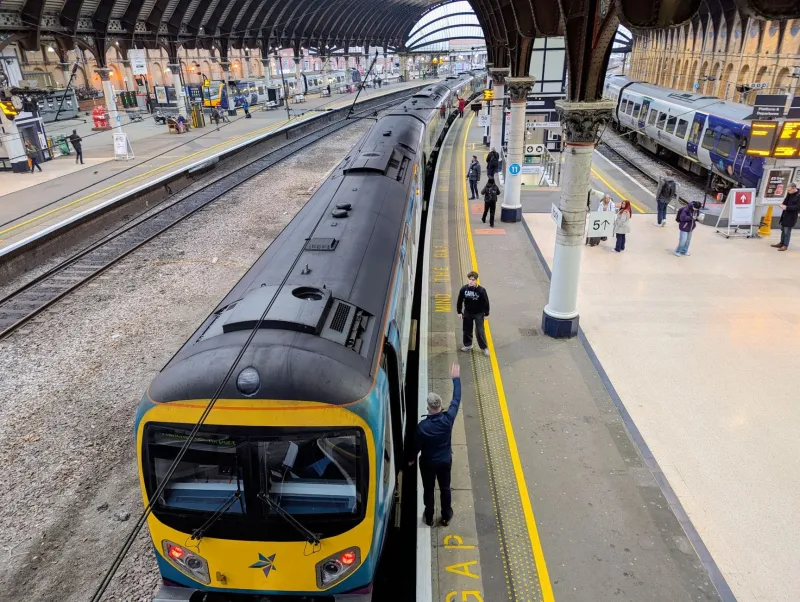
There is a particular kind of tired that only the 07:42 to Leeds produces. The kind where you are standing under the departure board with a lukewarm coffee, one earbud in, and a nagging feeling that you have already missed something important. For me, for most of my first year as a Muslim, that nagging thing was usually Dhur.
Nobody warns you that converting in a commuter town means your faith gets folded into a timetable built by someone else. So here is what I have learned, written down mostly so I stop forgetting it, and partly because a friend at the mosque asked me to.
The 07:42 Rule
My rule is simple and slightly unglamorous: whatever prayer window I am in when I board, I finish on the train or immediately at the other end. No heroics, no waiting for the perfect quiet moment. The perfect moment does not exist and, if it did, it would be cancelled for engineering works.
Practically, this means I know my prayer times before I leave the house, not when I am standing on a cold platform trying to load a website. A prayer app pinned to the home screen, set to my actual postcode rather than my parents' postcode that I have never updated in anything else, has saved me more times than I can count.
Wudu, Reviewed: The Station Toilet Question
Let us be honest about this one, because everybody asks it and nobody wants to be the person who asks it.
Station toilets are not a spiritual ideal. They are, however, sometimes the only option between a delayed connection and Maghrib. A few things that made it survivable for me:
- Carry a small bottle. A 500ml squash bottle in the rucksack does more for my religion than any book I have bought. Taps that only run for two seconds are a genuine trial.
- Learn the minimal wudu. You do not need to flood the sink. Washing the face, hands, arms, wiping the head and washing the feet is quick when you are not performing for an audience.
- Socks are a mercy. If you follow a position that allows wiping over socks, a decent pair of thick ones changes your whole morning. If you are not sure what your school of thought says, ask your local imam — not a stranger on the internet. Me, I asked a stranger on the internet first and had to apologise to my imam later.
- Check for multi-faith rooms. Some of the bigger stations have them, tucked away near the toilets or on an upper concourse. They are usually small, usually quiet, and almost always a better bet than a cubicle floor. Worth a look on the station map before you need one.
Finding Qibla on a Moving Train
There is something faintly ridiculous about holding a phone flat on a table while the carriage rattles, watching the compass needle spin like it has had three coffees. My first attempts were roughly as accurate as a coin toss.
What actually works for me:
- Work it out before you board. If I know the train runs broadly north, I know roughly which shoulder the qibla is over. Thirty seconds of thinking on the platform beats ninety seconds of spinning in a vestibule.
- Use the direction of travel, not the compass. Northbound, southbound, eastbound — the geography of the route is more reliable than any sensor on a train that is going through a tunnel.
- Accept approximation. Praying slightly off is not the crisis you think it is. Sitting down, facing as best you can, is permitted in circumstances like these, and it is infinitely better than missing the prayer entirely.
The Quiet Carriage Is a Lie, and That Is Fine
I once sat in the quiet carriage, waiting for a gap in the announcements, and ended up praying in a vestibule next to a man eating a pasty. Nobody died. He did not even look up.
Here is the thing about public prayer in Britain: most people are far too busy being British about their own business to make a scene about yours. The reactions I have had, in order of frequency: nothing, a polite sideways glance, a nod, one genuinely lovely conversation with a woman who asked if I was alright because I was sitting on the floor.
A few small things help. Face a wall or a window where you can. Keep it short if the carriage is rammed. Do not bellow the takbir. If someone asks, a three-second answer — 'just praying, back in a minute' — usually ends it kindly.
What Public Prayer Looks Like Outside London
In London, a man praying on a train barely registers. In a small Yorkshire town, you are, whether you like it or not, the first Muslim somebody has seen pray in public. That is not a burden you asked for, but it is real, and it does shape how you move.
I have found it is mostly fine, and occasionally lovely. The guard on my usual service now nods at me when I head for the vestibule. A woman on the platform once moved her suitcase so I had space. There is a particular kind of warmth in being quietly accommodated by strangers who have decided you belong on this train.
Three Apps and One Very Old Backpack
Nothing revolutionary here. A prayer-times app that lets me set my actual location and gives me a couple of different calculation methods. A qibla app with a manual mode for when the sensor gives up. And the operator's own app, because knowing the 07:42 is cancelled is arguably its own form of remembrance.
When It All Goes Wrong
Some days it does. The train is packed, the toilets are shut, the meeting overruns, and Qibla ends up being 'towards the window, probably.' On those days I pray late, or short, or sitting down in a stairwell, and I try to remember that the point was never to look tidy. The point was to keep showing up.
My first Ramadan on this commute, I broke fast on a Northern service with a date and a bottle of water and a man opposite me who said, 'That's a nice way to do it, that.' It was, actually. It still is.