What the Old Chapel Still Remembers: Praying in Britain’s Borrowed Buildings
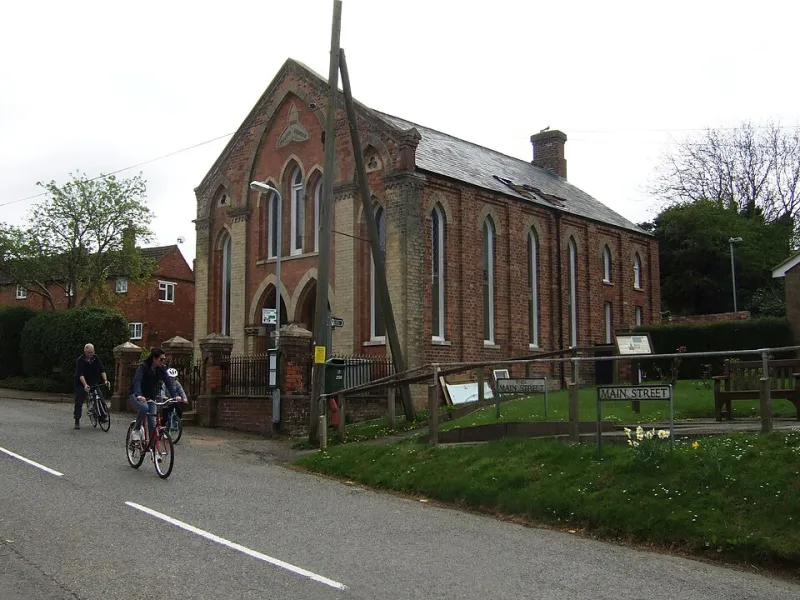
Photo: John M , CC BY-SA 2.0, via Wikimedia Commons
There is a particular smell in the mosque I visited last month. Floor polish, faintly floral, and underneath it something older — paper, dust, the ghost of hymn books kept in a wooden cupboard for decades. The building sits at the end of a village high street in the sort of place where the bus comes twice an hour and the parish noticeboard still advertises a Christmas fair in July. It used to be a Methodist chapel. Now it is a mosque.
I went because a friend from our conversion circle said, ‘You have to see the windows.’ She was right. They are tall, thin and unmistakably Victorian, with coloured glass that turns the afternoon light into something closer to a church than a prayer hall. Except there is no altar. There is a mihrab. There are no pews. There are shoe racks.
The Building Keeps Its Accent
Architectural detective work is not usually my thing, but a converted chapel makes it hard to switch off. The date stone above the door reads 1887. The organ loft is still there, now used for storage. The old hymn board has been taken down, but you can see the screw holes where it hung. Someone has painted the qibla wall a soft green. The carpet is newer than the building by about a century.
A trustee called Yasmin showed me round. She pointed out the lancet windows, the wooden roof beams, the place where the Sunday school used to meet. ‘We didn’t knock anything down,’ she said. ‘We just turned the chairs around.’ It sounds simple when she says it. It is not simple. It is a small act of translation.
What the Regulars Told Me
Yusuf, 64, grew up two streets away. He remembers coming to the chapel as a boy for a friend’s baptism. ‘I never thought I’d be back,’ he said. ‘But here I am, five times a day.’ He laughed. Then he said something that stayed with me: ‘The building has been a place of prayer for longer than any of us have been alive. We’re just the latest people to use it.’
Amina, who took her shahada in 2019, found the mosque through a Google search and a very patient WhatsApp group. She told me she cried the first time she prayed there. Not because of the building, but because of the welcome. ‘Someone brought me tea and didn’t ask me a single question about why I was there,’ she said. ‘That was the whole thing.’
The committee bought the chapel in 1998 after the Methodist congregation merged with another church down the road. There was a leaky roof, a broken boiler and a lot of fundraising. The minutes of those meetings are probably in a cupboard somewhere. I like to imagine them next to the old hymn books.
Borrowed Buildings, Real Belonging
Up and down the country, mosques meet in former churches, chapels, warehouses, community halls and terraced houses. This is not a strange footnote to British Islam. It is one of the main ways British Islam has grown: quietly, locally, in buildings that were already part of the neighbourhood.
That does not make these spaces less authentic. A mosque is not its dome. A mosque is a place where people pray, and argue about parking, and organise funerals, and teach children the Arabic alphabet, and forget to return the sugar. The building helps. It does not do the work.
What I liked about this chapel-mosque was the way it refused to pretend. The Christian history was not scrubbed away. It was not turned into a museum exhibit either. It was simply there, like an accent you keep after moving to a new city.
The Qibla and the Hymn Board
When I prayed there, I faced the qibla in a room that had once faced an altar. I did not feel like an intruder. I felt like a late arrival to a conversation that had been going on for generations. The floor polish and the paper and the dust did not distract me. They reminded me that faith in Britain has always been a patchwork of borrowed rooms and second chances.
The imam told me afterwards that the congregation had spent three years trying to fix the boiler. ‘We prayed for a new boiler more than we prayed for anything else,’ he said. I believed him. There is something very honest about a mosque that still has a faulty radiator and a noticeboard advertising a community litter pick.
A Quiet Kind of Growth
It would be easy to tell this as a takeover story, or a triumph story, or a decline story. It is none of those things. It is a story about a village, a building, and a group of people who needed a place to pray. The Methodist congregation moved on. The Muslim congregation moved in. The building kept working.
On my way out, I noticed the old noticeboard by the door. Someone had pinned a Ramadan timetable next to a faded notice about a harvest supper. Both were still there. I liked that. The chapel had not forgotten what it was. It had just learned a new prayer.